Every marketing leader faces the same question every year. Should you spend on quick wins or long-term brand value?
This question is more important than ever in 2026. “Budgets are tighter. Leadership is not promises; it is proof.
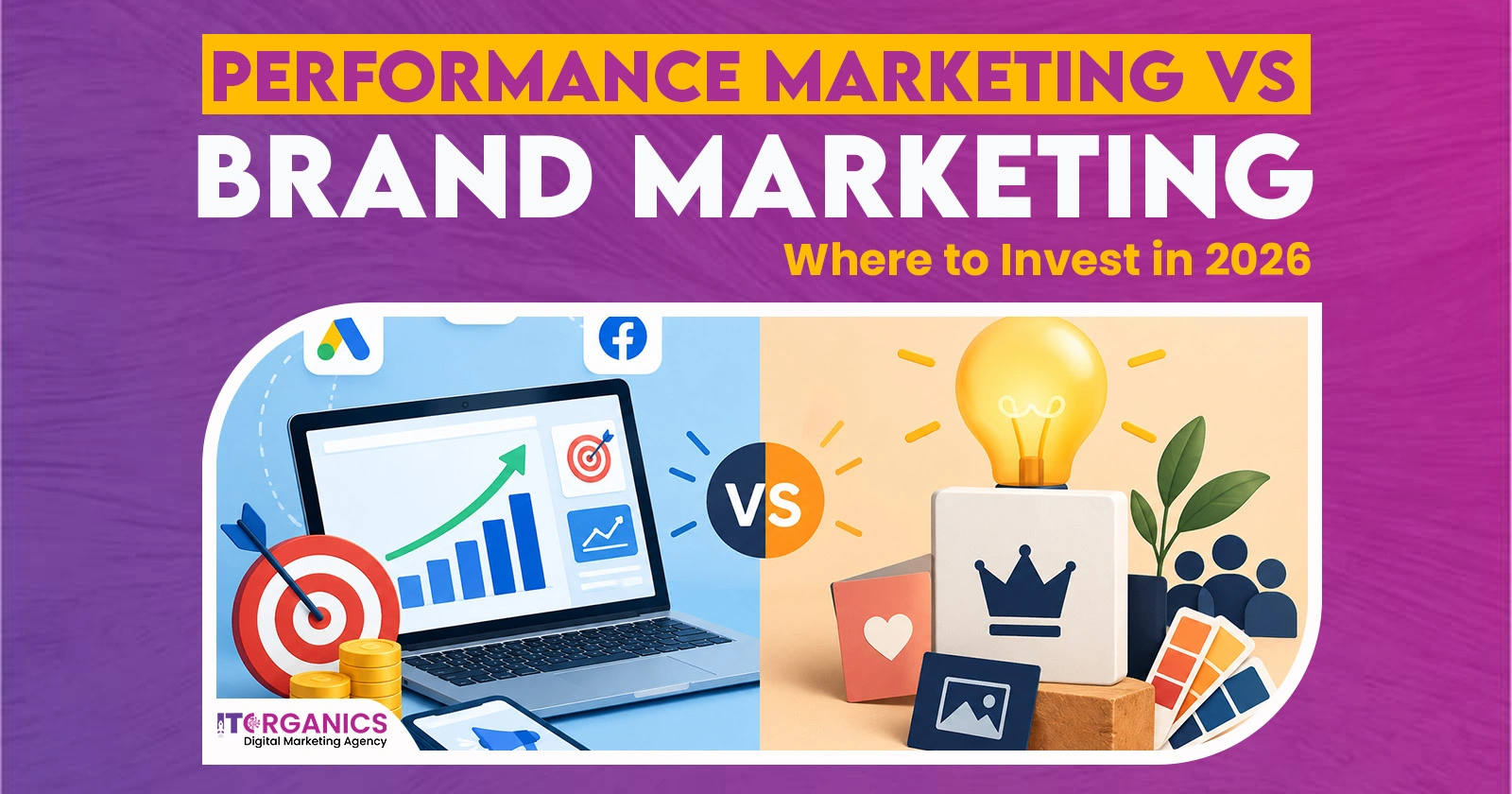
This is where the two pulls of performance marketing vs brand marketing are at odds and where smart companies get the balance right.
IT Organics LLC will create a plan that matches your budget and your goals, whether you’re looking for fast results or long-term brand equity.
What Is Performance Marketing?
Performance marketing is a model based on data. You’re billed for activities, not just impact. Such actions would be clicks, leads, signups or sales. Every dollar you spend can be tracked and measured.
Popular channels are Google Ads, Meta Ads, affiliate marketing & email campaigns. Each channel gives you clean numbers. You know exactly what was effective and what wasn’t.
Accountability is the biggest strength of performance marketing. You get results quickly. If a campaign is not working, you stop or fix it immediately. No need for guesswork.
This is what makes performance marketing a favorite for companies that need short-term results. Startups often rely on it to grow fast. E-commerce brands to drive daily sales. It’s tangible, quantifiable, and easy to communicate to leadership.
What Is Brand Marketing?
Brand marketing builds trust, recognition, and emotional bonds over time.
It affects the way people think about your brand. The question is why would one choose you over your competitor. It has to be patient.
Brand marketing does not imply immediate turnover like performance marketing.
It may take years or months to demonstrate its effectiveness. A powerful brand makes future performance marketing campaigns much cheaper and efficient.
Here, big companies such as Nike or Coca-Cola spend a lot of money. They’re not interested in today’s sale. They’re building the customer base of the future. Brand marketing takes time, but it adds up over time.
Performance Marketing vs Brand Marketing: Key Differences
Performance marketing delivers fast and measurable results. Brand marketing creates slow, but lasting value.
Another difference is in the measuring. Performance marketing is driven by metrics like cost per click, cost per lead and return on ad spend. Brand marketing uses softer measures such as awareness, sentiment and recall.
There are also variations in budget flexibility. Pause and launch performance marketing campaigns in real time. Brand marketing has to be consistent over months to work.
The risk levels are different too. “It’s less risky with performance marketing because you are tracking everything in real time. Brand marketing is a little more of a gamble, but it does save you from the sole reliance on paid channels.
Why 2026 Changes the Equation
Costs for ads are rising across all the major platforms. A click that cost a dollar last year could cost you more today. That means performance marketing is less predictable than it used to be.
At the same time, consumers are more skeptical about advertising. They look through generic promotions. They trust brands with a real identity and a consistent presence.
AI-powered search and answer engines are also transforming the way people find brands. With powerful brand recognition, you’re named in AI-generated answers, not just search results.
This shift is making pure performance marketing more costly and less dependable on its own.
Companies that pair it with brand building achieve better long-term returns.” The winning formula in 2026 is not “either or.” It’s a smart mix, weighted by your business goals and growth stage.
The ROI Model: How to Calculate Return on Performance Marketing
You need a clear ROI model to justify the spend. Here is an easy one.
Step 1: Total up your campaign spend, including management fees and ad spend.
Step 2: Use attribution tools to understand the total revenue that is directly driven from that campaign.
Step 3: Use this formula: ROI = (Revenue – Spend) / Spend × 100.
Step 4: Compare monthly ROI by channel. Shift budget to the best performers.
Step 5: Consider customer lifetime value, not just first purchase value.
A customer worth $500 over the course of a year is a very different proposition to a one-off $50 sale. The model works well for performance marketing, since all inputs can be tracked. Here are 5 steps to make a simple spreadsheet: Update it every month. This is your proof point at every budget meeting.
How to Justify Marketing Spend to Leadership
Start every conversation with ROI, not impressions/reach.
Just show a simple before and after. What happened when we put more into performance marketing? What did you do when you stopped it? Trust is built faster with real data than any pitch.
Have a dashboard with 3 numbers: Cost per acquisition Return on ad spend Revenue growth: Keep it visual and simple. A leader doesn’t need to have all the details—only the outcome.
If leadership wants growth, show how performance marketing acquires new customers. If they want stability, show them how much lower future acquisition costs are with brand marketing.
Finally, always give a range. Show what happens at the current budget, at 20% more, and at 20% less. This gives leadership control and makes your case data-driven, not emotional.
Where Should You Invest in 2026?
There is no correct answer. It is contingent upon where you are in the business.
Performance marketing should be the inclination of early-stage companies. You need to get quick feedback and revenue to survive. Every dollar has to justify itself quickly.
Brand marketing should be a bigger part of established companies’ mix. You already have clients. Now, you need loyalty and market position.
For many mid-size companies, a good starting ratio is 70 percent performance marketing and 30 percent brand marketing. As your brand grows, this can be closer to 50-50.
Track results quarterly. If your cost per acquisition keeps going up, this could be a sign that you should invest more in brand. If sales are steady, keep leaning on performance marketing for growth.
The best of both worlds. It’s performance marketing for today’s revenue and brand marketing for tomorrow’s advantage.
Final Words
Choosing performance marketing instead of brand marketing shouldn’t be a game of chance.
IT Organics LLC helps companies develop strategies that take advantage of both, with real data and clear goals.
The team builds and runs campaigns on Google, Meta, and other performance marketing platforms. We monitor every campaign with ROI models like the one above. Which means you always know what works.
Brand Marketing: IT Organics LLC develops content strategies, SEO campaigns, and messaging frameworks that build trust over time. Includes blog content, service pages & digital PR support.
FAQs
What will matter more in 2026, performance marketing or brand marketing?
Both are important. Pure performance marketing alone becomes less reliable as ad costs increase. If you add in brand marketing you get better results, and it costs less in the long run.
How do I calculate ROI for performance marketing campaigns?
Use the formula ROI = (Revenue − Spend) / Spend × 100. Track this monthly on each channel to know which is giving the best return.