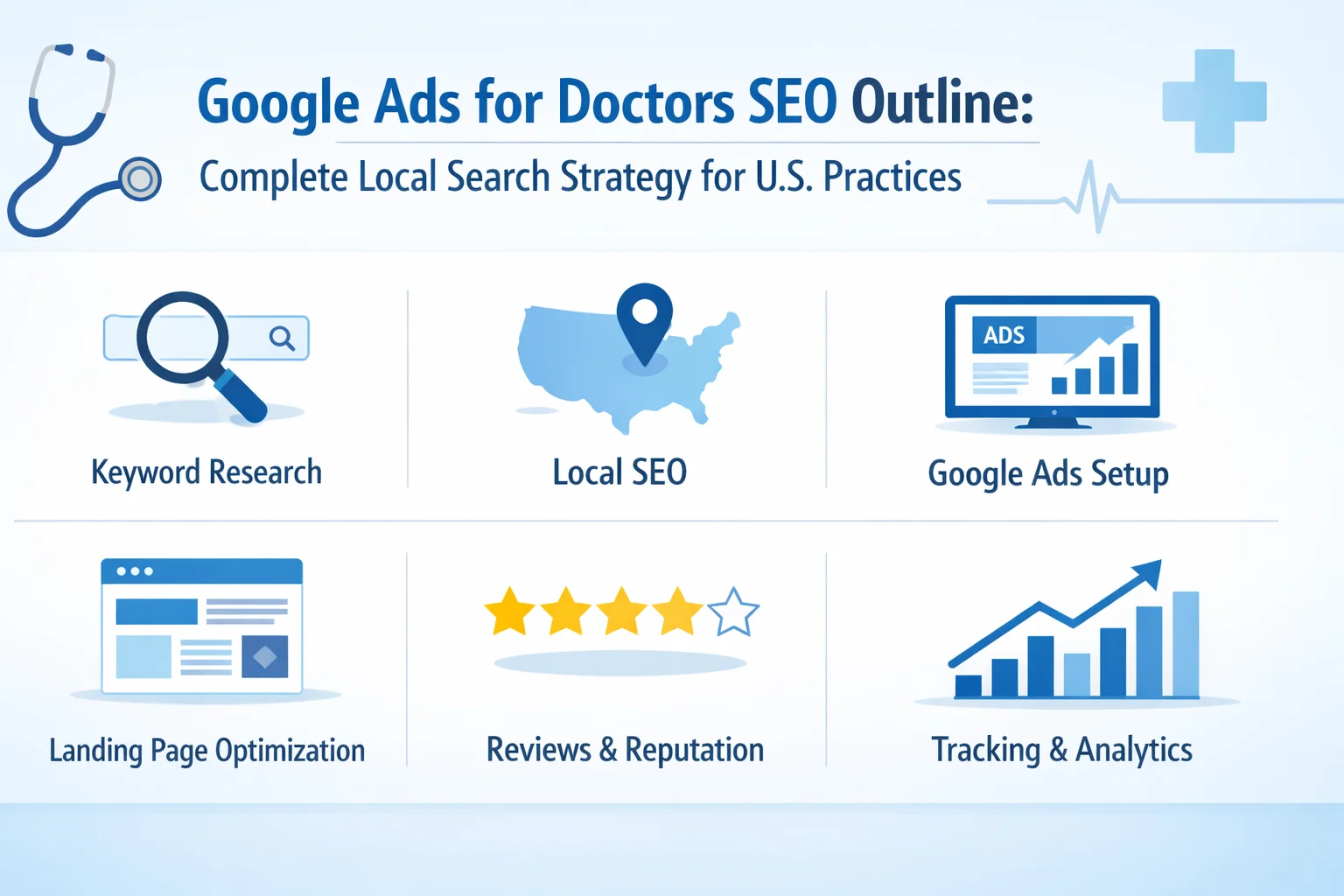
Google Ads for Doctors SEO Outline: Complete Local Search Strategy for U.S. Practices
Healthcare marketing in the United States has become increasingly competitive. Patients now search online before choosing a provider, compare reviews, evaluate websites, and often click on paid ads before booking an appointment. For medical practices that want immediate visibility, a structured Google Ads for doctors SEO outline is essential. A strong strategy combines paid advertising with local search optimization to increase calls, appointments, and revenue.
This complete guide explains how to build a results-driven system, covering medical Google Ads strategy for local markets, healthcare PPC keyword research, technical setup, schema implementation, auditing, and how AI digital marketing for startups can accelerate growth.
Why Google Ads for Doctors SEO Outline Matters for U.S. Medical Practices?
Unlike organic SEO, which takes months to generate results, Google Ads delivers immediate visibility at the top of search results. When patients search phrases like “primary care doctor near me” or “psychiatrist in Texas,” paid ads often appear before organic listings. This is why a focused local search Google Ads for medical practices strategy is critical.
Healthcare is a high-intent industry. Patients searching for medical services are usually ready to book. With the right targeting, ad structure, and landing pages, Google Ads can consistently drive qualified leads while supporting long-term SEO growth.
Medical Google Ads Strategy Local: Building a Strong Foundation
An effective medical Google Ads strategy local practices begins with geographic precision. Unlike eCommerce businesses, medical providers must focus on city-level or radius-based targeting. Ads should be shown only to patients within the service area to avoid wasted budget.
Local campaigns should align with specialties. For example, a cardiology clinic in Florida should not use generic nationwide targeting. Instead, campaigns should be structured by service lines, such as heart screening, stress tests, or follow-up care. This improves ad relevance and lowers cost-per-click.
Budget allocation should prioritize high-converting services. Reviewing historical data, seasonal trends, and patient demand ensures resources are invested where ROI is strongest. A well-planned medical Google Ads strategy with a local framework improves both click-through rates and patient acquisition costs.
Healthcare PPC Keyword Research Guide
No campaign succeeds without detailed keyword research. A professional healthcare PPC keyword research guide focuses on search intent rather than just volume. High-intent keywords such as “book pediatrician appointment Chicago” often convert better than broad terms like “child doctor.”
Keyword grouping should include:
- Service-based keywords (e.g., urgent care visit, anxiety treatment)
- Location modifiers (city, state, neighborhood)
- Insurance-related searches
- Emergency or urgent intent phrases
Negative keywords are equally important. Terms such as “free,” “salary,” or “medical school” must be excluded to prevent irrelevant clicks. Consistent keyword optimization ensures that your ad spend attracts real patients rather than casual browsers.
Google Ads Setup for Medical Practices
Proper Google Ads setup for medical practices determines long-term campaign performance. Account structure should separate campaigns by specialty and service category. For example, family medicine, dermatology, and mental health should each have distinct ad groups.
Conversion tracking must be configured accurately. This includes phone call tracking, appointment form submissions, and online booking confirmations. Without precise tracking, it is impossible to measure return on ad spend.
Ad extensions are essential for healthcare providers. Location extensions connect your practice to Google Maps. Call extensions allow patients to contact your office directly. Structured snippet extensions highlight services offered. These features improve visibility and increase click-through rates.
Landing pages must match the ad’s promise. If a user clicks on an ad for “same-day urgent care,” the landing page should clearly promote that service, display operating hours, and include a strong call-to-action.
Local Search Google Ads for Medical Practices
Local targeting goes beyond selecting a city. A complete local search Google Ads for medical practices strategy includes radius targeting around your clinic, ZIP code segmentation, and bid adjustments for high-performing areas.
Device targeting also plays a role. Many healthcare searches occur on mobile devices. Optimizing ads for mobile users, including click-to-call features, increases appointment rates.
Scheduling ads during business hours ensures your team can respond immediately to inquiries. However, for emergency or 24-hour services, running ads continuously may capture urgent care demand.
Local competition analysis is equally important. Reviewing competitor ads, offers, and landing page messaging provides insights for differentiation. Strong local positioning enhances both paid search performance and brand authority.
Google Ads for Doctors SEO Outline: Schema for Medical Practices
Although schema markup is primarily associated with organic SEO, Google Ads schema for medical practices supports credibility and visibility. Implementing structured data on landing pages helps search engines understand your business details, including name, address, phone number, specialties, and reviews.
Medical schema types can highlight:
- Physician credentials
- Medical specialty
- Accepted insurance plans
- Clinic operating hours
This structured data reinforces trust signals when patients evaluate your practice after clicking an ad. Consistency between ad content, landing pages, and schema improves Quality Score and overall campaign performance.
Google Ads Healthcare Local Search Guide: Integrating SEO and PPC
A complete Google Ads healthcare local search guide integrates paid and organic strategies. Running Google Ads does not replace SEO; instead, both channels work together.
For example, paid campaigns can quickly test keyword performance. High-converting paid keywords can later be incorporated into organic SEO content. Conversely, strong organic rankings reduce dependency on paid clicks over time.
Reputation management is another key component. Positive Google reviews increase click-through rates on ads and organic listings. Encouraging satisfied patients to leave feedback strengthens overall search visibility.
Consistency in NAP (Name, Address, Phone number) information across directories further enhances local authority. Integration ensures maximum exposure across search results.
Local PPC Audit Medical Google Ads
Regular optimization is critical for sustained performance. A structured local PPC audit and Google Ads process evaluates campaign efficiency and identifies opportunities for improvement.
An audit should examine keyword match types, conversion-tracking accuracy, ad copy performance, landing-page load speed, and budget distribution. Reviewing search term reports reveals irrelevant clicks and new keyword opportunities.
Cost-per-acquisition trends help determine whether bids need adjustment. If certain campaigns consistently outperform others, budget reallocation may improve ROI.
Auditing should occur at least quarterly, though high-volume practices may benefit from monthly performance reviews. Continuous refinement keeps campaigns competitive in evolving healthcare markets.
Compliance and Advertising Policies in Healthcare
Healthcare advertising in the U.S. must comply with strict regulations. Google categorizes medical-related ads under sensitive content policies. Practices must avoid misleading claims, guarantee statements, or unverified medical promises.
Additionally, HIPAA compliance remains critical. Patient data collected through landing pages must be secured properly. Working with experienced healthcare marketing professionals ensures campaigns remain legally compliant while achieving performance goals.
AI Digital Marketing for Startups in Healthcare
New medical practices often face budget constraints and brand visibility challenges. Leveraging AI digital marketing for startups can accelerate campaign efficiency and reduce manual workload.
AI-powered tools assist with automated bidding strategies, predictive keyword analysis, and real-time performance optimization. Machine learning algorithms identify high-converting search patterns and adjust bids accordingly.
Chatbots powered by artificial intelligence can also improve patient engagement on landing pages, increasing appointment booking rates. For startups, integrating AI reduces wasted ad spend while enhancing scalability.
However, automation should always be supervised by experienced strategists. Combining AI technology with human expertise produces the best outcomes.
Budget Planning for Medical Google Ads
Budget allocation depends on specialty competitiveness and geographic demand. Highly competitive fields such as cosmetic surgery or personal injury-related services often require higher monthly budgets. Primary care or family medicine may operate effectively with moderate spending.
Rather than focusing solely on cost-per-click, practices should evaluate cost per acquired patient and lifetime patient value. If a campaign generates long-term recurring visits, higher initial acquisition costs may still deliver a strong ROI.
Strategic scaling involves increasing budget only after campaigns demonstrate consistent profitability. Controlled expansion protects financial stability while maximizing growth.
Measuring Success and KPIs
Success in Google Ads for doctors should be measured through actionable key performance indicators. Important metrics include click-through rate, conversion rate, cost per lead, cost per appointment, and return on ad spend.
Phone call tracking is particularly valuable for medical practices. Many patients prefer calling directly rather than completing forms. Monitoring call quality and duration provides deeper insights into campaign performance.
Data-driven decisions ensure marketing investments contribute directly to revenue growth rather than vanity metrics.
Common Mistakes to Avoid
Medical practices sometimes make avoidable errors when managing Google Ads internally. Running overly broad keywords, failing to track conversions, ignoring negative keywords, or sending traffic to generic homepages reduces performance.
Another frequent mistake involves neglecting landing page optimization. Even the best ads cannot convert if the page lacks trust signals, clear calls-to-action, or fast loading speeds.
Professional strategy and continuous monitoring prevent these costly pitfalls.
Final Thoughts
A comprehensive Google Ads for doctors SEO outline provides a clear roadmap for success in local healthcare marketing. From building a precise medical Google Ads strategy local to implementing structured schema, conducting local PPC audits, and integrating AI digital marketing for startups, each component plays a critical role in patient acquisition.
In competitive U.S. markets, combining paid search with strong local SEO ensures maximum visibility. Practices that invest in structured setup, ongoing optimization, and compliance-focused advertising position themselves for sustainable growth.
With the right strategy, Google Ads becomes more than an advertising tool—it becomes a scalable engine for consistent patient flow and long-term practice expansion.